For shippers and BCOs, the real question behind kitting services ROI is simple: does product bundling lower total fulfillment spend enough to justify the added setup and coordination? The answer depends on order mix, labor rates, packaging design, and how often customers buy the same items together.
That is why the comparison between outsourced kitting and in-house pick-and-pack should be treated as a cost-benefit exercise, not a fixed rule. In some operations, bundle fulfillment improves speed, cuts touches, and supports margin growth. In others, standard handling remains the more efficient path. The goal is to identify where the numbers work.
What Kitting Services ROI Means
Kitting services ROI, or kitting return on investment, measures the financial return created when a company groups multiple items into a single shipment-ready set. At its core, the math compares what you spend on service fees, setup, and inventory handling with the savings and gains that result from better execution.
Those gains can include order fulfillment costs reductions, labor cost savings, fewer errors, stronger inventory accuracy, and better warehouse efficiency. For some shippers, the biggest improvement is faster fulfillment throughput. For others, the value comes from shipping cost optimization and more predictable planning around SKU management.
The right 3PL will take great care in evaluating your needs and building fulfillment decisions by total economic impact rather than isolated line items.
As reported by McKinsey & Company, “Almost 75 percent of consumers report having traded down, up from roughly 60 percent in 2020.” That shift matters because value-focused buyers are more likely to respond to tightly packaged offers that feel complete, efficient, and easier to purchase.
In practice, a sound cost-benefit analysis for kitting cost justification should include direct labor, storage, picking touches, shipping volume, and error correction. It should also account for how a third-party kitting provider changes workflow timing and internal resource use.
How Kitting Cuts Labor Costs
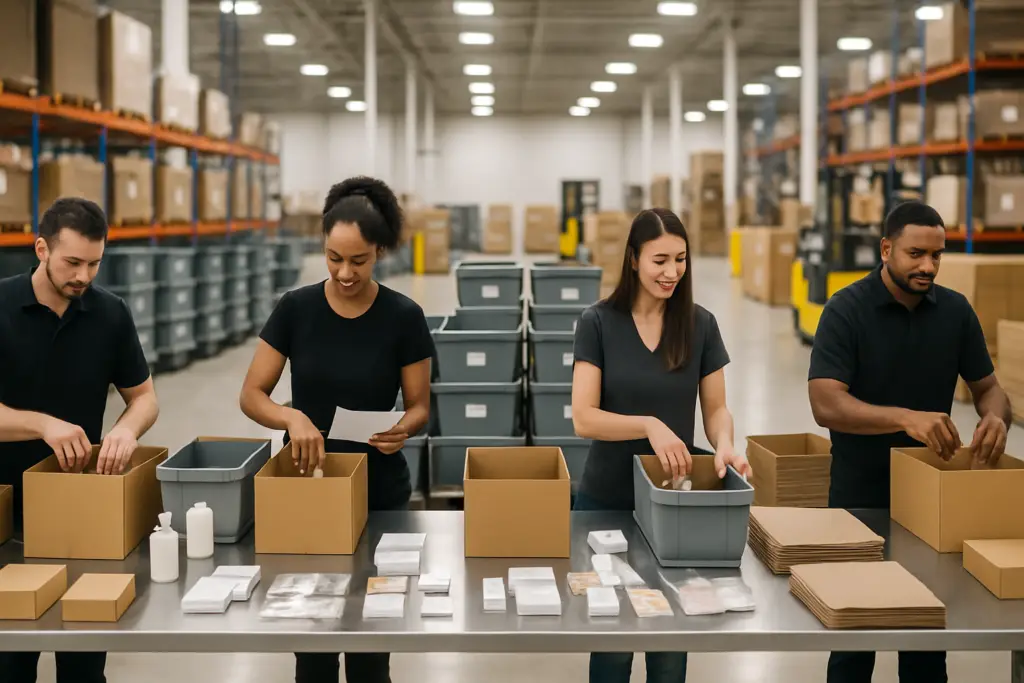
The labor case for kitting starts with one core idea: standardize repeat work so teams spend less time rebuilding the same order configurations. Done well, kitting lowers touches and protects throughput while improving consistency.
- Reduces repeated pick/pack/verify cycles for common order combinations.
- Cuts walking and motion waste through tighter kitting station setup.
- Improves pick and pack efficiency by batching repetitive assembly steps.
- Lowers rework by applying repeatable kitting quality checks before ship.
- Decreases exception handling tied to missing or mismatched components.
- Supports SKU consolidation so teams manage fewer active item-level decisions per order.
- Improves training speed for new labor on standardized assembly paths.
- Stabilizes staffing by shifting work into forecastable batch windows.
- Reduces overtime risk during surge periods with prebuilt ready-to-ship kits.
- Increases line productivity through better warehouse operations streamlining.
In high-volume environments, the labor impact compounds. A well-designed kitting station setup can streamline picking and packing optimization, reduce motion waste, and limit rework caused by missed items or incorrect combinations. The result is often a stronger mix of warehouse operations streamlining and lower overtime exposure.
SKU consolidation also plays an important role. When multiple items are managed as a single kit rather than separate units, the warehouse can simplify SKU management and reduce the chance of item-level confusion. That supports both faster processing and better order error reduction.
For shippers dealing with repeat bundles, a disciplined 3PL kitting partnership can create a more stable labor model. Instead of scaling headcount order by order, the facility can build kits in batches and keep productivity more consistent during peak periods.
Compare Kitting to Pick-and-Pack
Kitting services ROI becomes easier to see when you compare bundle fulfillment with traditional pick-and-pack. Pick-and-pack is flexible and often efficient for highly varied orders. Kitting, by contrast, pays off when demand patterns are repeatable and combinations are known in advance.
That means the better model depends on the order profile. If a customer regularly orders the same set of components together, outsource vs in-house kitting may favor a bundled workflow because it reduces repeated handling. If every order is unique, the added coordination may outweigh the benefit.
To compare fairly, measure cost per shipped order, touches per order, error rate, and processing time. If kitting lowers those numbers without increasing storage or service complexity too much, the economics are likely in its favor.
Measure Outsourced Kitting Financial Impact
When a company evaluates outsourced kitting, direct service fees are only the starting point. The real analysis should include labor savings, fewer corrections, inventory accuracy gains, and any reduction in customer service time tied to fewer mistakes. That is where inventory management improvement starts to show up in financial terms.
A reliable third-party kitting provider can also improve throughput by standardizing assembly steps and quality checks. Better quality control in kitting reduces returns, repacks, and customer complaints, which can otherwise erase the apparent savings of a lower-fee operation.
Standardized execution is often what turns potential savings into measurable margin improvement. In that context, custom fulfillment services can support cleaner workflows, stronger inventory accuracy, and less operational waste over time.
For a useful financial model, compare service cost against labor avoided, error correction avoided, and inventory gains created by tighter control. If the bundled process improves both speed and accuracy, the total return may justify the service even when the per-unit fee seems higher at first glance.
Lower Shipping Costs With Pre-Assembled Kits
Pre-assembled kits can lower transportation expense when they reduce package count, limit split shipments, or improve box configuration. In some cases, dimensional weight reduction creates meaningful savings because products are packed into a more efficient footprint before they leave the warehouse.
That is where shipping cost optimization becomes part of the ROI conversation. A kit may eliminate wasted void space, reduce excess packaging, and cut the number of cartons that move through the carrier network. Over time, those differences can improve order fulfillment costs even if the kitting process itself adds modest assembly expense.
Not every bundle saves money, though. Bundle design matters. If a kit is oversized, fragile, or poorly planned, the shipping advantage can disappear. Effective bill of materials management and demand visibility help ensure the final package is compact, stable, and economical to move. For businesses with recurring bundle demand, the combination of product bundling and smarter packaging can make shipping more predictable and scalable. That is especially helpful when teams are trying to balance service level goals with margin protection.
Value Beyond Cost Savings
The strongest cases for kitting services ROI are not always purely financial. Customers notice when a package arrives complete, organized, and ready to use. That can improve satisfaction, reduce friction, and support repeat purchasing without aggressive promotion.
ready-to-ship kits and careful quality control in kitting can also support a better unboxing experience and fewer service complaints. Even when the cost difference is small, the operational consistency may be worth it if the business sells into markets where presentation and reliability matter.
This is also where bundled offers can support broader strategy. A clean ecommerce bundle strategy may help brands convert shoppers who are seeking simplicity and value. At the same time, it can reinforce the customer perception that the company understands what belongs together. The best fulfillment relationships improve the customer experience through accuracy, speed, and consistency — all of which feed long-term value.
Scale Kitting for Growth
As order volume grows, kitting services ROI often improves because the labor and setup work can be spread across more units. That is one reason peak season fulfillment is such an important test of the model. If kitting helps a team absorb volume spikes without adding disproportionate labor, the return strengthens.
This is where supply chain scalability matters. A flexible 3PL kitting partnership can support changing order volumes, new product launches, and promotional surges without forcing a company to rebuild its internal operation every time demand changes. The ability to scale efficiently can be as valuable as the direct savings.
For subscription programs and recurring bundle programs, the model can be even more attractive. subscription box fulfillment often relies on repeat kit builds, consistent component counts, and dependable demand forecasting for kits. Strategic partners also propagate a broader point: the best operations create value when they combine physical execution with customer-facing consistency. Kitting works the same way. It becomes most useful when process discipline, forecast accuracy, and bundle design move together.
Improve Your Kitting Services ROI With Diamond Fulfillment Solutions
The strongest kitting services ROI appears when bundled products reduce labor, improve accuracy, streamline inventory, and lower shipping friction at the same time. That outcome is most likely when the order mix is repeatable, the packaging is efficient, and the fulfillment partner can manage the work without introducing extra complexity.
For shippers comparing outsourced kitting against in-house handling, the smartest next step is a structured cost-benefit review. Look closely at labor, touches, shipping, errors, and throughput, then test whether a third-party kitting provider can improve the full equation rather than just one line item. If you are weighing that decision, connect with Diamond Fulfillment Solutions to discuss a fulfillment model that fits your product mix and growth goals.