
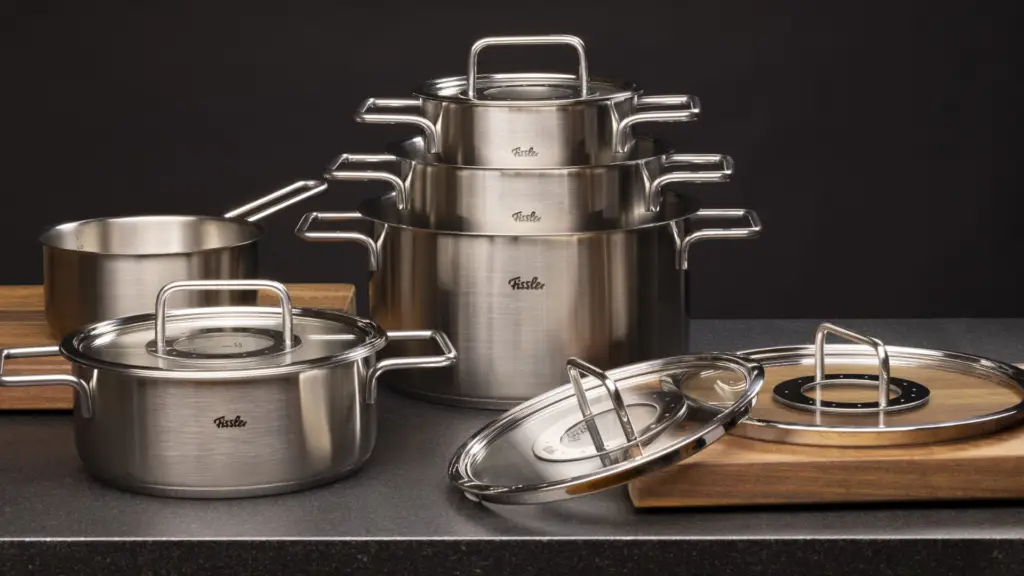
Fissler’s U.S. expansion shows how premium cookware fulfillment has to perform consistently across D2C, Amazon, Nordstrom, Bloomingdale’s, Macy’s and independent retailers. The sixth-generation German brand, founded in 1845 and made in Germany, needed an operation that could replace a legacy pallet-pusher model with stronger execution for channel complexity, presentation standards and compliance requirements. In this teaser, one number signals the shift: a 0.002% inventory variance rate.
Fulfillment Worthy of a Premium Brand
For cookware, standard pick-and-pack is rarely enough. Premium assortments require clean storage, controlled handling, protective packaging and retailer-compliant packaging aligned to channel expectations from receiving through final delivery. That is the baseline for dependable premium cookware fulfillment when product condition and presentation both shape brand perception.
The case study documents that operating discipline with a 0.002% inventory variance rate. Category context reinforces why this matters now: Circana’s recent omnichannel analysis points to continued channel-blending behavior that raises execution demands for premium housewares brands selling across D2C and retail.
Diamond Fulfillment Solutions’ cookware fulfillment services enable growth across this unique consumer-goods operating model.
Retailer Specific Packaging and Labeling
Retail requirements vary by destination, so packaging and labeling workflows must be built upstream rather than corrected late. For premium cookware programs, that includes retailer-compliant packaging and cookware set kitting configured to match channel rules at ship time.
Execution depends on dependable EDI and ecommerce integration across order data, inventory status and compliance inputs. When those systems align, teams can support omnichannel retail fulfillment with fewer preventable exceptions and cleaner handoffs from order entry to outbound processing.
This preview keeps the focus on validated case-study scope and does not extend into unstated capabilities outside the documented operating model.
Channel Order Accuracy
Inventory accuracy is central when one assortment serves D2C, marketplace and retail demand at the same time. In cookware ecommerce fulfillment, order precision and presentation quality both influence customer experience and channel performance.
Order control also extends into returns processing, where consistency protects the inventory picture and avoids downstream friction. The same operating standards must hold regardless of which channel originated the transaction.
This case-study preview stays focused on the topline result and the operating shift behind it; additional outcome detail appears in the full version only.
Branded Unboxing and Presentation
Branded unboxing has direct relevance in cookware because customers evaluate both function and perceived quality. Presentation quality therefore belongs inside the daily operating model for cookware ecommerce fulfillment, not as a separate afterthought.
Products must be packed, protected and staged to maintain presentation consistency from first touchpoint through delivery. That includes repeatable pack-station standards and material controls that support premium expectations across channels.
The case study provides fuller detail on how those workflows were operationalized while preserving a premium customer-facing experience.
Inventory Visibility Across Channels
Omnichannel retail fulfillment requires more than static stock snapshots. Teams need dependable visibility that supports allocation, replenishment and service-level consistency as demand moves between channels.
When visibility is strong, coordination between operations and merchandising improves. That helps protect commitments while keeping decisions grounded in current availability, not delayed assumptions.
Those controls set up the next challenge: scaling assortment breadth without weakening execution quality.
Scaling With SKU Optimization
Broader assortments increase complexity quickly, which is why SKU portfolio optimization is a core discipline in premium cookware operations. The goal is structured growth that preserves control, not simplification for its own sake.
In practice, cookware set kitting and returns processing must remain aligned with replenishment and planning rules as assortment depth grows. That is how teams scale while protecting service quality and compliance expectations.
Fissler’s U.S. trajectory shows what changes when a premium brand moves beyond basic 3PL execution to a more controlled fulfillment model built for channel complexity.
Download the Full Case Study
This teaser shares only part of the story. The full case study has the remaining metrics, the team’s own words and the complete operational playbook. Use the download form to get your copy.